Saudi Arabia Turns to US AI Targeting Technology as Houthi Attacks Continue
With Houthi strikes ongoing, Riyadh is relying on American intelligence and an AI targeting tool, raising questions about effectiveness and civilian risk.
By True Press Online Staff ·
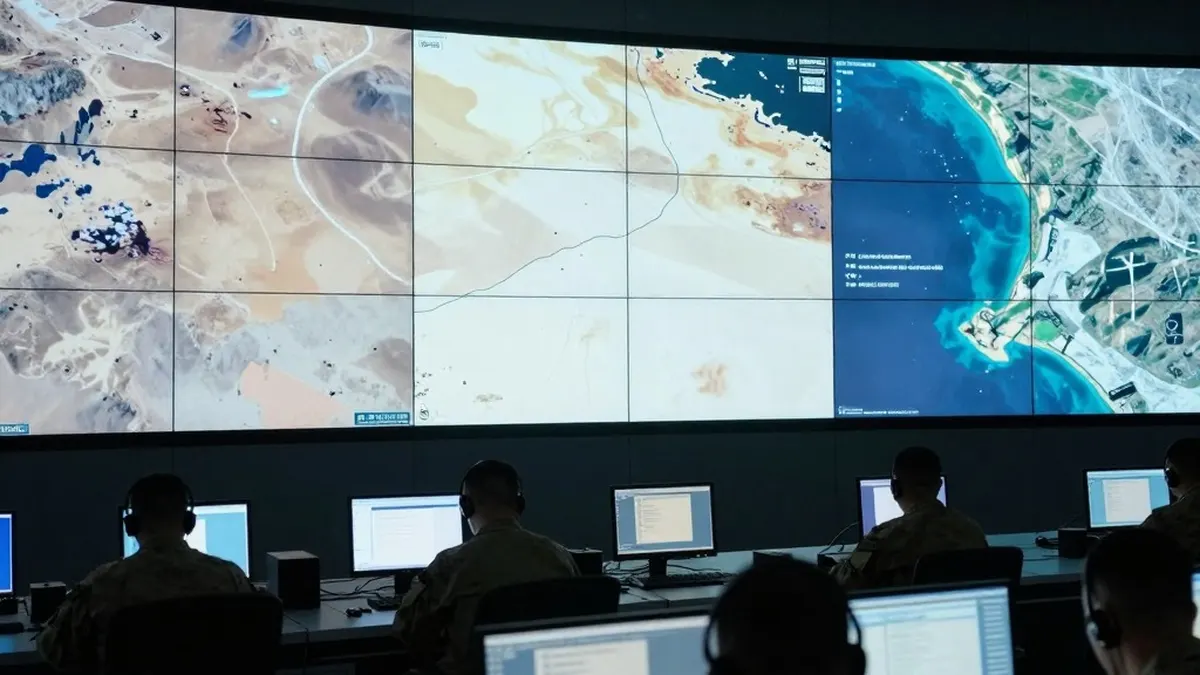
Saudi Arabia, under attack from the Houthi militant group in neighboring Yemen, has asked a number of allies for help. That includes the United States, even though media reports say US President Donald Trump declined when Saudi ruler Mohammed bin Salman asked him to order direct military action against the Houthis.
Washington is nonetheless supplying intelligence to Riyadh, including an artificial intelligence targeting tool. A September report by US broadcaster CNN, citing several unnamed American officials, said between 100 and 200 US soldiers were in Saudi Arabia as part of a new joint force command set up to support this effort. They were helping the Saudis "use a targeting tool that allows military officers to see in real-time what is happening on the battlefield," CNN reported.
Officials said the system resembles the Maven Smart System, or MSS, which the US military has also used when seeking targets in Iran, Iraq and Syria. MSS grew out of Project Maven, the American military's flagship AI program, launched in 2017. Analysts at the Center for Strategic and International Studies in Washington described it in June as a platform that "aggregates, organizes and visualizes vast streams of intelligence, surveillance and reconnaissance data."
The software finds patterns in material such as live satellite feeds and drone camera footage, then labels possible targets, including rocket launchers, tanks or suspicious vehicle convoys. The CSIS researchers noted that human analysts once had to comb through many separate sources, which was difficult and, with hours of footage, nearly impossible. MSS now merges hundreds of sources, flags potential targets and calculates the best way to hit them. Tech commentator Bilawal Sidhu, a former Google product manager, has called it a "Google Earth for war." The tool sharply shortens the "kill chain," the time needed to detect a target, judge whether it is dangerous and order a strike. When the US used MSS in its attack on Iran in late February, it hit more than 1,000 targets in the first 24 hours, compared with about 100 a day previously.
Yemen's civil war had been relatively calm after an informal ceasefire negotiated in 2022. The Houthis have held large parts of northern and western Yemen since 2015, while the internationally recognized government and other groups, backed by Saudi Arabia and the United Arab Emirates, control territory in the south and east. The group's latest campaign, which began in September, has given it more control of Yemen's coast, and it has stepped up attacks on Saudi Arabia, hitting the country's main airport and oil facilities. Campaigns against the Houthis by Saudi Arabia, the US and others have so far failed to weaken them significantly.
Farea al-Muslimi, a Yemen-focused research fellow at the UK think tank Chatham House, told DW that the Houthis take a "zero-sum approach." She said the group's founding father viewed modern Muslim societies as too "soft" and saw poverty and hardship as a divine test. "They don't care if the Israelis bomb the airport or the US bombs a hospital," she said, adding that this serves them because their ideology centers on martyrdom and sacrifice.
Users have also noted technical limits of MSS. The Houthis are highly mobile, using truck-mounted ballistic missiles and small drone swarms from hills and canyons in rugged terrain, so fighters could be gone before a strike lands. The system works best in sparsely populated areas, and shifting desert terrain, dust storms, high wind, snowfall, dense foliage and deliberately planted decoys can all reduce its success rate.
There are ethical concerns as well. A human is supposed to verify each target the AI identifies and decide how to respond, but that does not always happen. Among the sites MSS targeted in Iran on the first day of the war was a school, where an American missile killed almost 200 people, most of them children aged between seven and 12.
Israel's Gospel system, known as Habsora, is the closest equivalent to MSS and has been used in Gaza. Analysts Frederic Wehrey and Andrew Bonney wrote for War on the Rocks that the technology improved situational awareness and strike speed, but that these gains were "overshadowed by mounting civilian deaths reportedly resulting from this technology's safeguards being loosened or eliminated." Australia-based independent journalist Antony Loewenstein told DW he sees little evidence that AI tools will change the situation on the ground, apart from causing large numbers of civilian casualties. He said the US and Saudi Arabia will find that the Houthis have "an incredibly high tolerance level for destruction."
Source: Deutsche Welle